

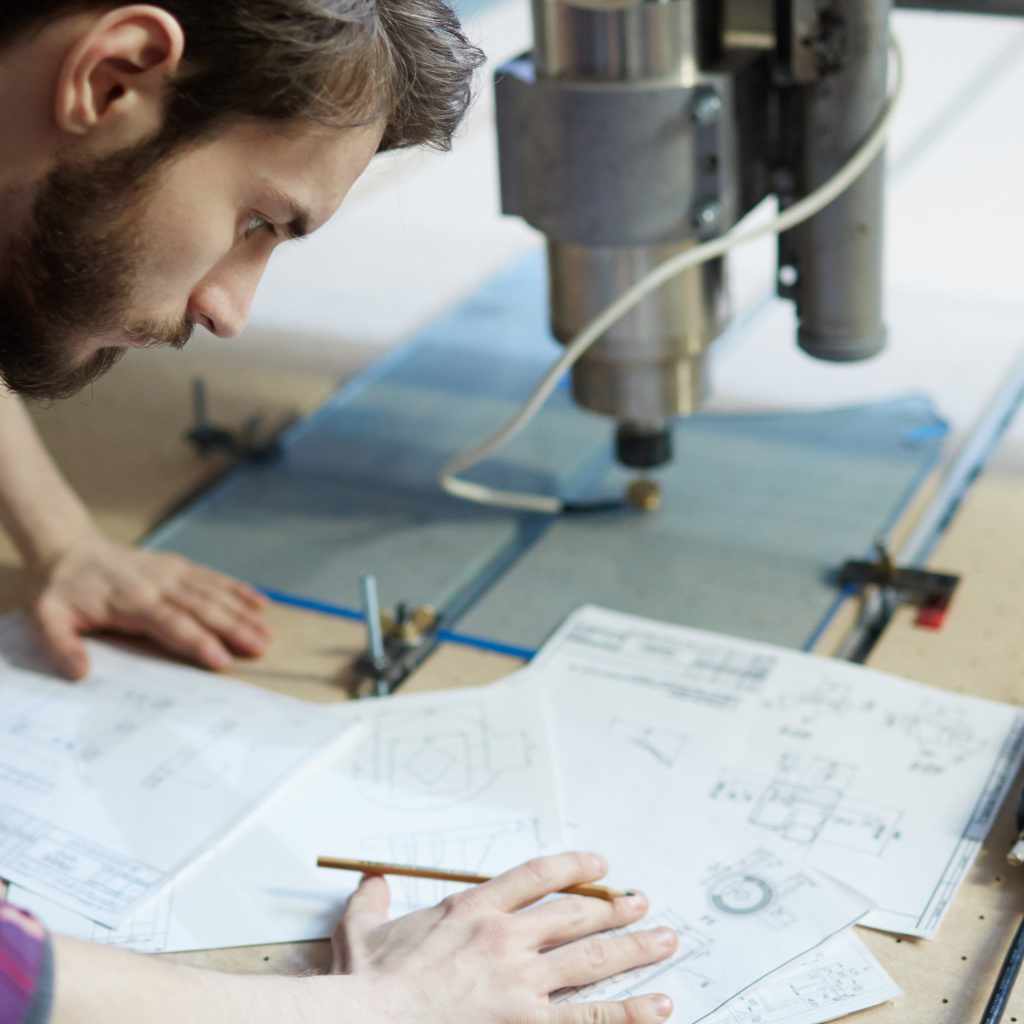
In the industrial world, even the most brilliant idea remains just that until it becomes a functional, tangible component. Mechanical prototyping is the bridge between design and production reality, and at Ingotools we consider it one of our most strategic specializations.
We manufacture prototypes starting from technical drawings, physical samples or even early-stage concepts that customers need to validate before investing in expensive tooling or mass production.
What we mean by mechanical prototyping
A mechanical prototype is not just a model: it is a fully functional component that must perform exactly like the final product. It must have the same mechanical characteristics, the same tolerances and the same materials as the production version.
The difference lies in the manufacturing method: while the production part may be created through molds or automated processes, the prototype is produced through direct machining from solid stock or semi-finished raw materials.
Our prototyping methods
- Machining from solid: We start from bars, plates or blocks of the final material and machine the entire component using CNC processes. Ideal when mechanical properties must match the final product exactly.
- Modification of existing cast parts: Often customers already have “similar” cast components that need adaptation. We 3D scan them, redesign the required changes and perform targeted machining operations.
- Reworking die-cast components: The same principle applied to aluminum or brass die-cast parts that require additional machining to become fully functional.
A project that reflects our philosophy
A few months ago, a company in the hydraulic sector brought us the drawing of a custom control valve body. They needed five prototypes for functional testing before deciding whether to invest in production tooling.
We produced the prototypes from solid brass, machining all internal channels and connections with production-level precision. The prototypes performed perfectly during testing, but adjustments were required on one internal groove to improve flow performance.
Result: we delivered three modified prototypes within a very short timeframe, allowing the client to refine the design before investing tens of thousands of euros in final production tooling.
Materials used for prototypes
Material selection is crucial. We manufacture prototypes in:
- Brass: Ideal for hydraulic and pneumatic components. Excellent machinability and corrosion resistance.
- Aluminum: Lightweight and versatile, suitable for mechanical and structural components.
- Copper: Used when specific thermal or electrical conductivity is required.
- Steel: For prototypes that must withstand high loads or severe operating conditions.
The collaborative development process
Our strength in prototyping lies in our collaborative approach:
- Phase 1 – Analysis: We evaluate the application together with the customer and define the most effective prototyping strategy.
- Phase 2 – Design: When necessary, we optimize the drawing for prototype manufacturing while preserving functional characteristics.
- Phase 3 – Sampling: We produce the first prototype for dimensional and functional verification.
- Phase 4 – Testing and adjustments: The customer tests the prototype and provides feedback for potential improvements.
- Phase 5 – Pre-series: Once validated, we manufacture a small batch for extended testing.
The advantages of 3D scanning
When customers already have a physical component to modify or replicate, 3D scanning becomes an essential tool. It allows us to:
- Digitize existing components without technical drawings
- Compare prototypes with original parts
- Detect deformation or wear on in-service components
- Create digital archives of critical components
Realistic lead times
A simple prototype can be ready within 2–3 working days. More complex geometries or special materials require 5–7 days. For pre-series production, lead times depend on quantity: typically 5–10 pieces within one week, with larger quantities evaluated case by case.
From prototype to mass production
Our goal is not only to produce prototypes but to guide the customer toward full-scale production. During the prototyping phase, we gather valuable insights that we then share:
- Critical issues identified during machining
- Suggestions for design optimization for production efficiency
- Recommendations on the most suitable materials
- Guidance on the most efficient production processes
Quality control for prototypes
Even for prototypes, quality is never compromised:
- Complete dimensional inspections using calibrated instruments
- Surface quality verification
- Functional testing where applicable
- Photographic documentation and measurement reports
Conclusion
Mechanical prototyping is far more than simple machining: it is applied consulting, problem-solving and technical partnership. Every prototype we manufacture reflects deep knowledge of production processes and practical industrial experience.
Do you have an idea to turn into reality?
Contact us to discuss your project: together we will define the most effective prototyping strategy and realistic lead times.

